
A Gold Sound hobby — and a fitting one.
Like vintage audio, classic cars are about pleasing engineering and design that lasts, and they’re woven through American history and culture. The cars of the 1950s and ’60s even inspired the look of many a classic amplifier front panel. Here’s what’s in the collection.
1965 Plymouth Valiant Signet convertible
Fewer than 2,000 Valiant convertibles were built in 1965 — and only a few hundred with the high-performance V8 and four-speed manual, which makes this one genuinely rare. (For perspective, Ford built over 100,000 Mustang convertibles that same year.) Early Valiants are favorites of road and drag racers as the lightest V-8 Mopars ever made; at the first Daytona compact-car race, six-cylinder Valiants swept the first seven places.
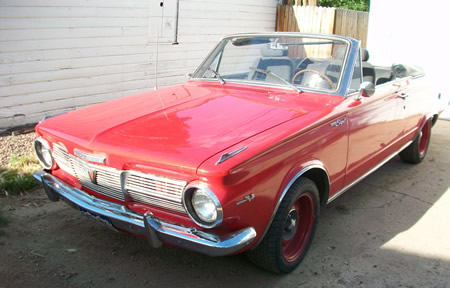
You may have seen the model and color before: Elvis drives one in Paradise, Hawaiian Style; Paul Hogan drives an Australian-built Valiant pickup to the Outback in Crocodile Dundee; and the car appears on the Twin Fin wine label.
- Under the hood — a 360 V-8 with an Edelbrock RPM Air Gap intake, four-barrel carburetor, milled heads, dual exhausts, electronic ignition, and an aluminum radiator with electric fans.
- Chassis — limited-slip differential, front and rear sway bars, 17-inch aluminum wheels, vented and slotted SSBC disc brakes (13-inch front, 10-inch rear), and a later Mopar four-speed overdrive manual. Its 8.75-inch rear axle was the same one Chrysler put under Barracudas, big-block 440 cars, pickups, vans, and even Checker cabs.
1948 Chrysler Windsor
On the far left, a 1948 Chrysler Windsor with a 251-cubic-inch flathead six. Chrysler’s flathead sixes were workhorses: they powered Dodge military four-wheel-drive trucks and Power Wagons from 1940 to 1968, and five of them combined into a single 30-cylinder engine drove a number of Sherman tanks. A 1948 Chrysler is the getaway car in Exodus, and the woody “Town & Country” convertible version (1947–50) was a Hollywood favorite — Bob Hope among them.
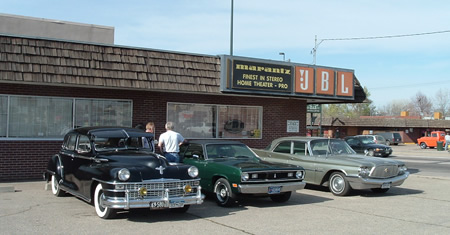
1972 Plymouth Duster
The 1972 Plymouth Duster is the two-door coupe version of the Valiant compact — and a Duster like it appears on the cover of the Cars album Heartbeat City. With its 340-cubic-inch V8, around 300 horsepower, and a curb weight near 3,000 pounds, the Duster could “dust off” many a big-block car.
1960 Chrysler Windsor
The 1960 Chrysler Windsor was designed by Virgil Exner, one of Detroit’s most influential stylists — who also penned the 1957 300C below. A biography of Exner features this very model on its cover. Andy Granatelli set records at Bonneville running close to 200 miles per hour in a modified 1960 Chrysler 300F.
1957 Chrysler 300C
The 1957 Chrysler 300C runs a 392-cubic-inch hemi V8 with dual four-barrel carbs and 375 horsepower — the most of any 1957 car, with a 390-horsepower version optional. The “300” nameplate began in 1955 on the first U.S. car to make 300 horsepower, and the hemi V8 still powers dragsters and boats making over 3,000.
It was a technical showcase: Chrysler’s first torsion-bar suspension and a pushbutton TorqueFlite three-speed automatic. Its optional RCA under-dash record player beat the cassette and the 8-track by a dozen years — a fitting feature for a car that lives at a hi-fi shop. The styling was revolutionary too: low and long, with far more glass and far less chrome than its peers, and widely copied. It inspired the modern Chrysler 300C, and a 2007 U.S. postage stamp featured a ’57 300C in this same color.
There’s usually something interesting parked out front. Stop in — Ron’s always happy to talk cars, or amplifiers.